
Operations · 9 min read
Reliable Small-Business Automation: Designing the Work Around Failures
Published
A desk-research framework for intake, CRM updates, retries, data quality, reconciliation, and accountable human handoffs.
About this analysis
- Approach
- Desk research & analysis
- Evidence reviewed
- 2026-11-20
- Sources
- 4 linked references
Research question: How can a small team automate customer intake without losing requests, duplicating work, or making staff reconstruct failures?
No original experiment or client outcome is claimed.
Published
A small-business automation is dependable when staff can tell what happened, recover what did not happen, and avoid repeating work that already succeeded. Connecting a form to a CRM and an email service is only the beginning. The operational design must explain what happens when those systems disagree, respond late, or become unavailable.
This desk-research study combines current platform documentation with a proposed workflow review method. It includes no original performance experiment, customer study, or claim that Cenate has deployed the example. Its reader question is practical: how can a small team automate customer intake without losing requests, creating duplicates, or making staff reconstruct every failure by hand?
Start with one business promise
Use a hypothetical service business that accepts project inquiries online. A customer submits contact details and a brief. The business wants to preserve the request, add it to its CRM, assign a staff member, and send a receipt. A receipt acknowledges arrival; it must not imply that a quote, appointment, or response deadline has been accepted unless those commitments are actually supported.
Write the promise in ordinary language before choosing tools: each accepted inquiry has a durable record and an accountable next step. That is more useful than saying that four applications are connected. It gives the owner a basis for deciding what the customer should see and what staff must be able to recover.
Keep the first scope narrow. A shared inbox and CRM rule may be sufficient for a low-volume operation. Custom development becomes easier to justify when existing tools cannot expose partial progress, enforce necessary permissions, or support a manageable recovery procedure. The review should be able to conclude that no new software is needed.
Define separate states for separate outcomes
For the proposed workflow, use distinct states such as received, CRM sync pending, assigned, and notification pending. These labels describe different facts. An inquiry can be safely stored even when a confirmation message has not been delivered. A notification can be sent while staff assignment remains unresolved. A single green success badge conceals those distinctions.
Choose one authoritative location for the original inquiry and preserve its identifier through each downstream operation. Record the CRM record identifier once available. Let staff see the latest confirmed outcome and the next required action. A correction should not erase the fact that an earlier attempt failed or that somebody completed a step manually.
Avoid turning every technical detail into a customer-facing status. The customer may need a receipt number and a clear next step; the operator needs the failed destination, attempt history, and recovery controls. Design those views for their respective decisions rather than exposing raw provider errors to everyone.
Validate data before it becomes somebody else's problem
Agree which fields are required and why. An inquiry might need a reply address and a brief, while budget and timeline remain optional. Distinguish missing information from a deliberately unanswered question. Automatically filling an absent deadline with today's date would create a plausible-looking record that misrepresents the customer.
Define field ownership at the level that matters. The intake record owns what the customer originally submitted. Staff may maintain a separate normalized company name in the CRM. If a customer corrects a phone number, record the update and decide which downstream copies must change. Blindly replaying an older submission should not reverse the correction.
Prepare a mapping sheet with source field, destination field, accepted format, required status, and behavior when validation fails. Include long names, international phone formats, duplicate-looking companies, and unsupported attachments. These are proposed test cases, not claims about the accuracy of any specific platform. A clear mapping often reveals that the process needs simplification before it needs more automation.
Separate receipt from downstream processing
Incoming webhooks need verification before their contents are trusted. Shopify documents signed deliveries, duplicate detection, prompt acknowledgment, queued processing and periodic reconciliation. Its guidance provides a concrete example of why receiving an event and completing the resulting business task are separate responsibilities. Shopify's delivery documentation is the underlying reference.
For the hypothetical inquiry system, preserve accepted work before telling the customer it has been received. A background worker can then perform CRM and notification steps. If the downstream service is unavailable, the saved record should remain visible. This is a proposed architecture, not a claim that placing work in any queue automatically makes it durable.
Ask the implementer where the work survives a process restart, how a stuck item is discovered, and what happens if storage fails before acknowledgment. Those questions are more informative than asking whether the application uses a fashionable queue product. The answer should identify a specific persistence mechanism and a recoverable state.
Give retries the right identity
A repeated request and a new customer request are not always the same thing. A browser retry after a slow response should normally refer to the original submission. A customer returning tomorrow with a new brief should normally create new work. Do not deduplicate everything by email address; one customer can legitimately have several requests.
Stripe's idempotency documentation illustrates how a stable key can distinguish a retry from a new operation. It also specifies different behavior for API v1 and v2. That distinction matters: a general instruction to add an idempotency key is not a complete recovery policy. Check the semantics of the actual endpoint and version. Stripe's idempotent-request reference documents those boundaries.
For this proposed design, keep an internal submission identifier and separate identifiers for downstream actions. An inquiry-to-CRM operation and a receipt-email operation should not be interchangeable. A worker restarting after the CRM accepted a record needs to find or recognize that record, rather than create another simply because its local response was lost.
Where a destination cannot safely deduplicate writes, choose a controlled alternative. That may be a lookup using a stored external reference, an approval step for uncertain outcomes, or a manual recovery procedure. Explain the remaining uncertainty to the operator. Do not label a workflow exactly-once merely because duplicate delivery was considered.
Retry temporary failures, not every failure
AWS's guidance explains that a timeout does not prove an operation had no effect, and that repeated attempts can worsen an overloaded dependency. It discusses bounded timeouts, backoff and jitter as tools for managing transient failures. This is an established engineering reference, not a new release or evidence of a particular business's results. AWS's retry guidance supplies the underlying principles.
Translate those principles into an operator-readable policy. A temporary connection failure can remain pending for a limited retry period. A missing permission, rejected field, or disconnected account generally needs a different response. Write down who resolves each category and when unattended attempts stop. Do not quietly retry a malformed record forever.
Choose retry timing from the business deadline and the provider's limits. There is no universal schedule appropriate for both a low-priority reporting export and a time-sensitive customer message. After the automatic budget is exhausted, move the item into a visible exception queue with its original context. Avoid stacking independent retry loops without understanding their combined effect.
Reconcile outcomes instead of trusting arrival order
Stripe states that webhook delivery order is not guaranteed and that duplicate events can occur. Its documentation recommends tracking event identifiers and retrieving relevant objects when needed. This supports an important boundary: a sequence of incoming messages is not automatically a reliable picture of current business state. Stripe's webhook documentation describes that behavior.
For the inquiry example, reconciliation means periodically comparing accepted inquiries with confirmed downstream outcomes. Which records lack a CRM identifier? Which assigned requests still await notification? Which records were closed manually but remain queued? Define those comparisons before choosing how frequently they run.
A reconciliation report should produce work someone can complete. Show the request reference, missing outcome, last confirmed action, and proposed next step. Avoid emailing a spreadsheet full of raw exceptions to a general inbox with no owner. The goal is a controlled recovery path, not another stream of messages that staff must manually interpret.
Make the human handoff a real workflow
An exception queue needs an owner, a substitute, and an expected review rhythm. The operator should be able to claim an item, understand why it stopped, and either correct it, complete the remaining step manually, or close it with a reason. Record that decision so the automated worker does not subsequently undo it.
Consider a hypothetical CRM outage. An inquiry has been saved, but the customer is asking for help before the connection recovers. Staff may respond through an approved manual channel and record that response against the inquiry. When syncing resumes, the system should create or match the appropriate CRM record without sending an obsolete acknowledgment as if nothing happened.
Approval must also have a specific meaning. Reviewing a customer's contact data is different from approving a price or committing to a delivery date. Keep consequential promises in the appropriate business process. A queue-clearance button should not accidentally grant authority to change commercial terms.
Test the uncomfortable cases before expanding
Ask for a short, repeatable acceptance exercise. Submit the same request twice with the same retry identity. Interrupt processing after the CRM write but before local confirmation. Reject a required field. Disconnect a credential. Deliver an older update after a newer correction. Have an operator complete an item manually, then restart processing.
For each case, define the expected business result before running it. Count records and messages, inspect the final state, and verify that staff can recover without editing a database directly. These are recommended checks; this article reports no measured pass rate. Preserve evidence of what was tested and what remains outside the first release.
Include the customer experience. If storage fails, do not show a receipt that implies acceptance. If a request is saved but later processing is pending, do not ask the customer to keep resubmitting it. Clear status language reduces uncertainty without pretending every downstream service is always available.
A practical readiness checklist
- Name the customer promise, authoritative record, and workflow owner.
- Map required fields, corrections, identifiers, and destination responsibilities.
- Distinguish accepted work from CRM, assignment, and notification outcomes.
- Verify incoming events and persist accepted work through restarts.
- Define duplicate handling separately for each business action.
- Set bounded retries and route non-temporary failures to an accountable person.
- Reconcile missing outcomes and resolve manually completed work safely.
- Test interruption, duplication, permission failure, stale updates, and recovery.
- Agree on access ownership, monitoring, handover documentation, and maintenance.
Choose the smallest system that staff can operate
The operating burden belongs in the scope. Estimate time for reviewing exceptions, maintaining mappings, renewing access and checking platform changes alongside implementation cost. Measure completed customer tasks and unresolved work before claiming savings. A faster form submission is not useful if staff must spend longer repairing the handoff.
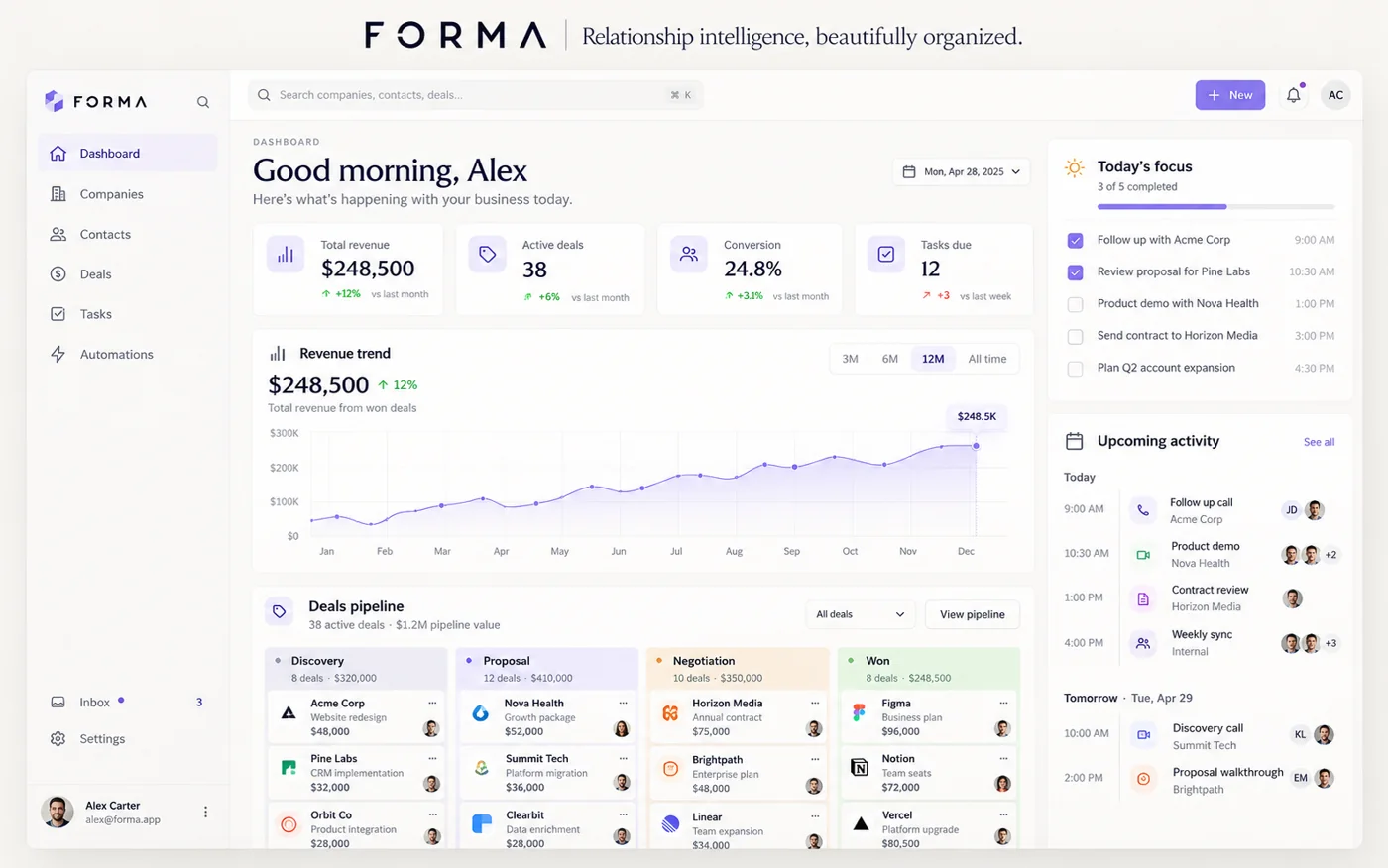
The prototype-to-business-software guide covers broader launch responsibilities. This study focuses on maintaining one connected process after launch. Explore Cenate's automation service and the Forma CRM interface showcase for relevant design context; the showcase is not evidence that this example is deployed. Bring your existing tools, failure cases and ownership constraints to the project inquiry.
Preserve the request before moving the work
- Receive
Validate and save one authoritative inquiry.
- Sync
Track the CRM outcome independently.
- Assign
Give the next action an accountable owner.
- Notify
Record the receipt or remaining notification work.
- Reconcile
Resolve missing outcomes and manual completions.
Different failures need different next steps
| Condition | Proposed response |
|---|---|
| Temporary connection failure | Bound retries and retain pending work. |
| Rejected field or permission | Route to an accountable person. |
| Uncertain prior write | Verify the destination before repeating. |
| Manual completion | Record it so automation does not duplicate it. |
What this study does not establish
- A queue alone does not establish durability or exactly-once outcomes.
- Idempotency and retry behavior depend on the provider, endpoint and version.
- The inquiry workflow is hypothetical; no observed completion rates are reported.
Evidence & further reading
- Shopify: verify webhook deliveries
Living primary documentation checked November 20, 2026; verification, duplicates, queuing and reconciliation.
- Stripe: idempotent requests
Living primary documentation checked November 20, 2026; API-version-specific semantics. No universal guarantee inferred.
- Stripe: receive events in your webhook endpoint
Living primary documentation checked November 20, 2026; duplicate delivery and non-guaranteed ordering.
- AWS: timeouts, retries, and backoff with jitter
Background engineering guidance published December 5, 2019; current destination checked November 20, 2026. No original experiment or benchmark.